
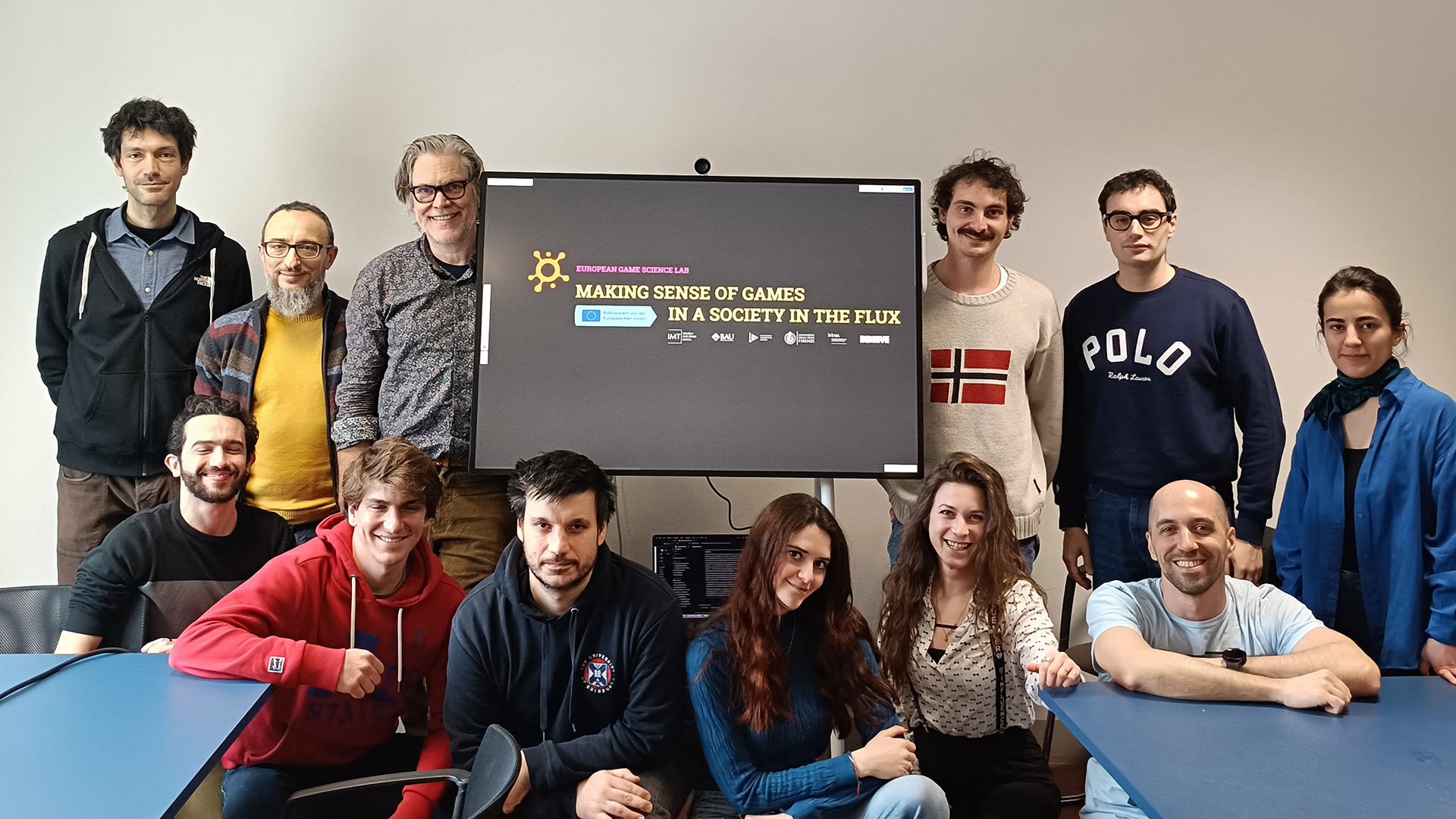
The first joint international workshop of the European Game Science Lab project, organised by IMT Lucca, focused on the concept of creating games in an evolving society. Game Science: Discussion about a new discipline The discussion centred on ‘game science’ as a relatively new field of research and its place in the scientific spectrum.
Participants discussed how game science differs from existing approaches. Not just game theory: It goes beyond the mathematical modelling of strategic interactions. Not just game design: More than just a design perspective. Not just game studies: Expanded to include quantitative methods and consider cultural, anthropological and social factors.
Game science takes a broader, multidisciplinary approach. The basic idea is that games and gaming could become an important common language of the coming century. Understanding this development requires a discipline combining quantitative and qualitative methods of analysis — an area underrepresented in game studies to date. Another topic of discussion was the project’s planned theoretical framework. The aim is to develop an integrative understanding of game design that is independent of the respective aggregate states of games, such as children’s games, board games, digital games and role-playing games.
Practical focus: Game design teaching The three-year project will focus on the further development of game design teaching and the concept of ‘game literacy’ as a practical skill for various educational areas.
The methodological core of the project was discussed: the breakdown of existing game design practices and teaching methods into individual building blocks. These cover various aspects, from game mechanics and themes to other components of game design. The aim is to develop new game design teaching methods based on these building blocks.
The workshop marked the beginning of the project, which aims to advance game design education through a multidisciplinary approach combining game theory and game design with analogue and digital teaching methods.